How To Travel With Breast Milk By Car: Expert Tips For Your Journey

Disclosure: I may get commissions when you click through the affiliate links (that are great products I stand by) on my articles. You can read the full disclosure for more information. Content is intended for informational purposes only and does not constitute medical advice.
Working out how to travel with breastmilk by car doesn’t have to be as complex as it sounds. As a seasoned breastfeeding counselor and mom of two, I’ve been there, done that. Through my own experiences and professional insights, I’ve mastered the art of keeping liquid gold safe and nutritious while on the move.
Whether you’re planning a long road trip or simply need to transport your milk across town, ensuring your breast milk remains perfectly preserved is vital. In this guide, I’ll share essential tips on maintaining the quality of your breast milk during car travels, from cooling strategies to storage solutions. We will also cover how to travel with frozen breast milk by car.
Let’s go on this journey together, making sure your precious cargo arrives just as fresh and nourishing as when it left.
Key takeaways
- Properly storing and transporting breast milk is crucial for maintaining its nutritional value.
- Preparation before the journey is key to a successful trip, including packing a high-capacity cooler and prepping your breast pump and bottles.
- During the journey, keep breast milk cool and avoid exposing it to extreme temperatures. After the journey, clean and sanitize your breast pump and bottles.
How to travel with breast milk by car: equipment needed
Mothers rarely travel light! Take a few minutes to gather everything you will need for your journey. Having a well-prepared kit can make the journey smoother and ensure the safe handling and storage of breast milk.
Essential kit for traveling with breast milk:
- Insulated cooler bag – Portable and efficient for keeping breast milk cool.
- Ice packs or frozen gel packs – Reusable ice packs to maintain a cold environment in the cooler bag.
- Breast pump – A portable breast pump (manual or electric with a car adapter).
- Storage bottles or bags – Leak-proof, sterile breast milk storage bags or bottles.
- Labels and markers – For labeling bags/bottles with the date and time of expression.
- Cleaning supplies – Mini bottle brush, soap, and sanitizing wipes to clean pump parts and bottles.
- Battery pack or car adapter – For electric pumps, to ensure you can pump anywhere.
- Breast pads – To manage any leakage during the trip.
- Hand sanitizer – To ensure cleanliness when handling breast milk or pumping.
- Nursing cover/burp cloths – For privacy if pumping in public places or while in the car.
Optional items:
- Portable breast milk cooler – A specialized cooler designed specifically for breast milk, offering optimal temperature control.
- Thermal flask with hot water – Useful for warming bottles or cleaning equipment on the go.
- Power inverter – If your breast pump or other devices do not have a car adapter, a power inverter can convert your car’s DC to AC power.
- Breastfeeding/nursing pillow – For added comfort during stops if you choose to breastfeed directly.
- Digital thermometer – To monitor the temperature inside your cooler bag, ensuring it stays within safe limits.
- Breast milk testing strips – For checking the quality of breast milk if unsure whether it’s still good.
- Extra clothing – In case of spills or leaks, having an extra shirt can be a lifesaver.
- Portable washing station – A small basin, bottle of water, and towel if you need to wash parts on the go.
- Solar-powered charger – For ensuring your electronic devices and pump stay charged during long trips without access to power.
Adjust the list based on the length of your trip, your specific needs, and the storage capabilities at your destination.
Before you set off
Traveling with breast milk can be stressful, but with a little preparation, it can be done smoothly! Here are some tips to help you prepare for your journey.
1. Understand the importance of storing your breast milk safely
Breast milk must be stored and transported at the right temperature to maintain its quality. Otherwise, it can spoil and become unsafe for your baby to consume.
The ideal temperature for breast milk storage is between 32°F and 39°F (0°C and 4°C).
Here are some breast milk storage guidelines to keep in mind:
| Storage Method | Guideline |
|---|---|
| Container selection | Use clean containers with tight-fitting lids. |
| Labeling | Mark containers with the date and time the milk was expressed. |
| Placement in cooler/refrigerator | Place breast milk in the back where it’s coldest. |
| Mixing fresh and frozen milk | Avoid mixing fresh breast milk with previously frozen milk. |
| Cooler bag with ice packs | Breast milk can be stored for up to 24 hours. |
| Refrigerator | Breast milk can be stored for up to 4 days. |
| Freezer | Breast milk can be stored for up to 6 months. |
You might like to try pooling your milk in one container to make it easier to travel with.
2. Choose the right cooler
Choosing the right cooler is important if you want to bring breast milk on your journey as they can keep it fresh and safe. Look for a cooler that is sturdy, leak-proof, and has enough space to hold your breast milk containers. Some popular options include:
- Soft-sided coolers: These are lightweight and easy to carry. They are also flexible, so they can fit into tight spaces in your car.
- Hard-sided coolers: These are more durable and can provide better insulation. They are also easier to clean.
- Cooler bags: These are designed specifically for breast milk storage and transportation. They often come with ice packs and can fit inside a larger bag or backpack.
We love the BABEYER Breast Milk Cooler Bag with Ice Pack
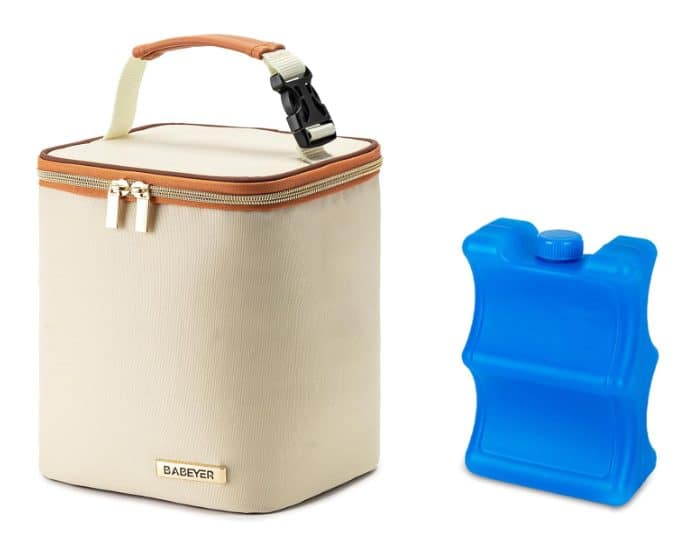
Designed with love and care, this cooler ensures that your baby’s nutrition is always at the right temperature, no matter where you go.
- Perfect fit for daycare: This cooler can comfortably fit 4 of the tall Dr. Browns bottles, making it ideal for daycare. Plus, there’s a little extra space for essentials like a bib or an extra onesie.
- Optimal size & design: It’s neither too big nor too small. With the ability to fit 4 bottles snugly between the ice packs, it’s the perfect size for daily use. The added bonus? It can also hold bottled water perfectly and straps onto diaper bags with ease.
- High-quality insulation: Whether you’re commuting to work, heading to daycare, or just out for a stroll, this cooler ensures that your breast milk remains fresh. The included ice pack is a game-changer, offering extended cooling capabilities.
3. Learn how to use your cooler and ice packs effectively
The cooler/ice pack combo is essential for keeping breast milk cold or frozen while traveling. Pack them in your cooler or bag. Here are some tips for using them effectively:
- Before you pack your breast milk, chill both the milk and the cooler if possible. A pre-chilled cooler will keep things colder for longer.
- Pre-freezing your ice packs overnight will ensure they are fully frozen and ready to use when you need them.
- Use high-quality ice packs for maximum efficiency. Place them strategically around the milk containers to ensure even cooling.
- Use enough ice packs to keep your breast milk cold for the entire journey. A good rule of thumb is to use one ice pack for every four to six ounces of breast milk. Place ice packs on top of and underneath your breast milk containers to ensure even cooling.
- Believe it or not, a fuller cooler stays cold longer than one that’s half-empty. If you don’t have enough milk to fill the cooler, fill the remaining space with additional ice packs.
- Make sure your cooler’s lid is tightly sealed at all times. Every time you open it, you let cold air out and warm air in, so try to minimize how often you open it.
4. Packing your breast pump
If you plan to pump during your journey, it’s important to pack your breast pump properly. Here are some tips:
- Pack the pump in its own bag: Packing the pump in its own bag will keep it clean and protected.
- Pack extra pump parts: Pack extra pump parts in case you need to replace any during your journey.
- Bring cleaning supplies: Bring cleaning supplies such as wipes or soap to clean your pump after each use.
My favourite breast pump and breast milk storage backpack: Fasrom Breast Pump Bag Backpack

The Fasrom Cooler Backpack is a versatile and stylish solution for on-the-go mothers. Compatible with most breast pumps, this backpack ensures your breastmilk stays fresh with its insulated compartment. With ample storage and a chic pink finish, it’s not just functional but also a fashionable accessory for modern moms.
- Large capacity: The top compartment is compatible with various breast pumps like Spectra S1, S2, Medela Freestyle, Pump in Style, Swing, Willow, and Elvie. It has 6 pockets inside, including 2 insulated pockets for baby bottles and pumping accessories.
- Cooler compartment: Specifically designed for storing and transporting breast milk storage bottles. The bottom compartment is lined with aluminum film material to keep breastmilk fresh and prevent liquid leaks.
- Three carrying options: It offers adjustable padded shoulder straps, a reinforced top handle for daily carrying, and a back luggage strap to secure the backpack on a suitcase, making it travel-friendly.
5. Plan your route
When planning your route for traveling with breast milk by car, it’s all about striking the right balance between structure and flexibility.
First up, let’s talk about scheduling those all-important pumping stops. Before you even buckle up, take a moment to think about your usual pumping or breastfeeding routine. How often do you need to pump to keep things comfortable and your milk supply steady? For most moms, this means planning a break every 2-3 hours. But make sure you work around your baby’s current feeding schedule.
Now, with that in mind, it’s time to get friendly with online maps or GPS apps. Map out your journey, keeping an eye out for potential pit stops. You’re looking for rest areas, parks, or any safe and cozy spots where you can take a break and pump or feed in peace.
But here’s the thing – life on the road is full of surprises. Traffic jams, unexpected weather, or a particularly fussy travel companion can throw your plans out the window. So, while it’s great to have a plan, it’s just as important to stay flexible. Think of your schedule as more of a guideline than a strict timetable. It’s always better to factor in a little extra time, just in case you find yourself needing to stop more often than anticipated.
During the car journey

Going on a journey with breast milk in tow means keeping a keen eye on maintaining the right temperature for your liquid gold. Here’s how you can keep things cool, calm, and collected during your car journey.
1. Maintain breast milk at the right temperature
During your car journey, one of the most critical aspects to keep in mind is the temperature at which the breast milk is stored. This becomes particularly important on longer trips where the risk of temperature fluctuations increases. To ensure that the breast milk remains safe and fresh, monitor the temperature closely and know how to maintain the optimal conditions.
- Use a thermometer: Incorporating a small, digital thermometer inside your cooler is a brilliant move. It serves as your eyes within, allowing you to keep tabs on the internal temperature without the need to open the cooler and risk disturbing its carefully maintained cool environment. This can be particularly useful in maintaining the quality of the breast milk over extended periods of travel.
- Know the safe zones: Awareness of the safe temperature zones for breast milk is crucial. The milk should ideally be kept at or below 39°F (4°C) to ensure its safety for your baby. Monitoring the temperature allows you to react promptly if it begins to rise, enabling you to take corrective actions such as adding more ice packs or repositioning the cooler within your vehicle to a cooler location.
- Choose the right location: The placement of your cooler in the car can significantly affect its ability to maintain the desired temperature. Keep the cooler out of direct sunlight and away from the car’s heater vents, as these can cause the temperature inside the cooler to increase. A cooler spot, such as the floor behind the front seats, can be ideal. Additionally, if your car is equipped with air conditioning vents in the rear, positioning the cooler near these vents can help keep it cool.
This proactive approach helps in preserving the milk’s quality and provides peace of mind knowing that your baby’s nutrition is being handled with the utmost care.
2. Safely pump on the move
Do you think you might need to pump during your journey? Here are some tips to ensure a smooth experience:
- Choose the right pump: Depending on your preferences and the length of your journey, consider a manual pump for its simplicity and quiet operation, a battery-operated pump for its portability, or an electric pump with a car adapter for efficiency.
- Use a hands-free pumping bra: A definite pumping essential, this can be a game-changer for pumping on the go, allowing you to pump safely without needing to use your hands.
- Plan your pumping stops: If you prefer not to pump while the vehicle is moving, plan your stops in advance. Look for safe and comfortable places where you can take a break to pump.
- Stay hydrated and comfortable: Keep water and snacks within reach, and wear comfortable clothing that makes pumping easier.
- Secure the pump: Make sure your pump is securely placed on a flat surface to prevent it from falling or spilling milk.
When it comes to maintaining your privacy while pumping in the car, there are several strategies you can employ. First and foremost, investing in a nursing cover or using a lightweight blanket or large burp cloth can provide you with a discreet way to pump, even when parked in more public locations.
Additionally, utilizing sunshades or even a towel draped over the windows can offer an extra layer of privacy. If you’re concerned about being seen, look for more secluded spots to park, such as the back of a parking lot. Remember, your comfort and the safety of pumping come first, so find what works best for you and your baby’s needs.
3. Properly handle and store your milk
After mastering the art of safe and comfortable pumping on the move, the next step is to transfer your breast milk to storage bags or bottles. This transition is crucial, as it’s not just about collecting the milk; it’s about maintaining its integrity until it’s time for your baby to enjoy it.
- Always transfer breast milk into clean and sterilized storage bags or bottles specifically designed for breast milk. This helps keep the milk safe for consumption. Not sure how many bottles you need? Check out this post.
- If you’re pumping multiple times during your journey, cool the newly expressed milk before adding it to the cooler. This helps maintain the temperature and quality of all the stored milk.
- Leave some space at the top of bottles or bags to allow for expansion, especially if you plan to freeze the milk later.
- Make sure the storage bags or bottles are sealed tightly to prevent any leaks or contamination.
- Label each storage bag or bottle with the date and time the milk was expressed. This practice helps you use the oldest milk first and ensures that the milk is used within a safe period. Clear labeling takes the guesswork out of feeding time, especially for caregivers so that they choose the right bottle at the right time. Proper labeling reduces the chances of wasting breast milk, ensuring that none of your hard-earned milk goes unused.
Post journey care

Once you’ve arrived at your destination, you’ll need to take care of your breast milk and pumping supplies. Here are some tips for handling breast milk post-journey, along with tips on checking its quality and using stored milk.
1. Transition the milk from your car to a fridge or freezer
If any expressed milk has been kept at room temperature during the journey, cool it as quickly as possible. Breast milk can safely stay at room temperature (up to 77°F or 25°C) for about 4 hours. Once at your destination, transfer the breast milk to a refrigerator if you plan to use it within the next 4 days. If breast milk has been at room temperature for more than 4 hours, it’s safer to discard it to avoid the risk of bacterial growth.
For longer storage, move it to the freezer. Here’s a handy guideline for storage durations:
| Storage Location | Storage Duration |
|---|---|
| Refrigerator | Up to 4 days |
| Freezer | Up to 6 months |
| Deep Freezer | Up to 12 months |
Be sure to label your breast milk with the date and time it was expressed so you can keep track of how long it has been stored. This helps in using the oldest milk first and prevents waste.
2. Using stored milk
Safely thaw frozen milk in the refrigerator overnight or by placing the container in a bowl of warm water for quicker thawing. Avoid using a microwave, as it can destroy nutrients and cause hot spots that might burn your baby’s mouth. Never shake your breast milk! Once fully thawed, breast milk should be used within 24 hours if kept in the refrigerator. Do not refreeze thawed milk.
Next, warm the milk to room temperature or just slightly warm by placing the bottle or bag in a bowl of warm water. Always test the milk’s temperature on the inside of your wrist before feeding. After warming breast milk, use within 2 hours and discard any leftovers to ensure safety.
Check the milk quality of stored breast milk using this chart:
| Criteria | Description |
| Smell and taste test | Fresh breast milk has a mild, slightly sweet smell and taste. If it smells sour or tastes off, it’s best to discard it. |
| Consistency | While frozen breast milk might separate into layers, this is normal. Gently swirl the milk to mix it. However, if the milk remains lumpy or has curdled after warming, it should not be used. |
| When to discard | Milk that’s been stored longer than recommended durations, smells sour, or has been warmed but not used within 2 hours should be discarded. |
3. Clean your equipment
It’s important to clean your pumping supplies after each use to prevent the growth of bacteria. Here are some tips for cleaning your supplies:
- Wash your hands before handling your pumping supplies.
- Disassemble your pump and wash each part in warm, soapy water.
- Rinse each part thoroughly with hot water.
- Allow the parts to air dry on a clean towel or drying rack.
You can also use a dishwasher to clean your pumping supplies. Be sure to place them in the top rack and use a hot water cycle.
Wrapping up your journey
As a breastfeeding counselor and a mom to two wonderful children, I want to share a bit of my own journey with you. I have a fair amount of experience pumping and facing the challenges of long car journeys with my babies! It’s from these personal adventures and professional insights that I’ve gathered the knowledge shared in this guide.
Traveling with breast milk by car can seem daunting at first, but with the right preparation, tools, and mindset, it becomes much more manageable. My hope is that the tips and strategies outlined here will help you feel more confident and supported as you embark on your travels with your little one.
To all the breastfeeding mothers out there gearing up for travel, know that you’re not alone. Your dedication to providing for your baby, even on the go, is commendable. Keep going strong, and may each mile bring you closer to mastering how to travel with breast milk by car.
Traveling with breast milk FAQ’s

Generated with Pin Generator


